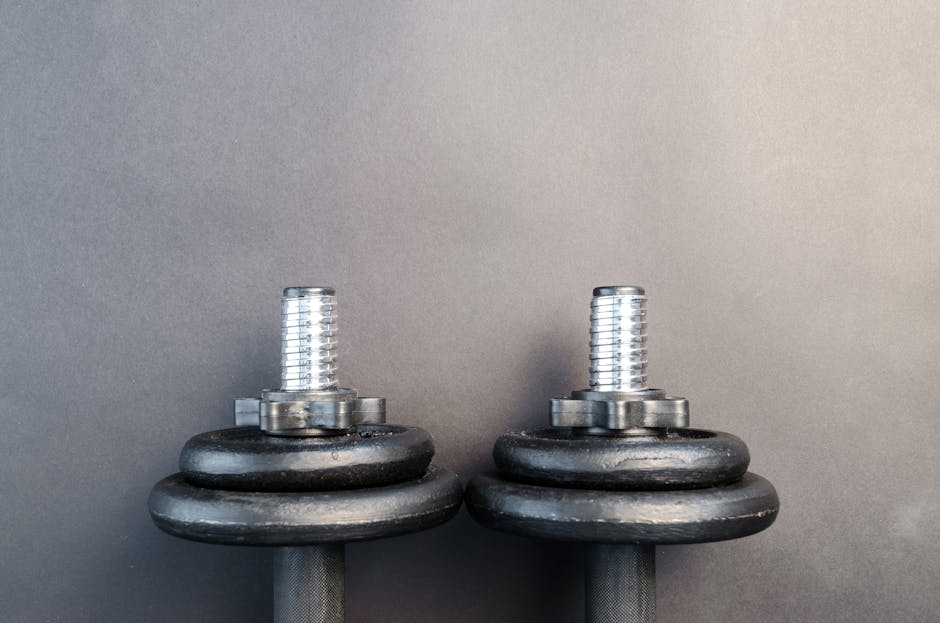
Photo: Lukas Blazek / Pexels
Found this helpful? Share it!
Our team evaluates home gym gear, training tools, and workout accessories so you don't have to. Every recommendation is based on real research: customer reviews, expert opinions, and value for money. Learn more about us →
When evaluating What Weight Dumbbells Should A Beginner Start With (2026), the key factors to consider are build quality, long-term durability, and whether it genuinely solves the problem it claims to address.
Most beginners should start with 5–10 lb dumbbells for upper-body exercises and 10–20 lb dumbbells for lower-body and compound movements. Women new to strength training typically do best starting at 5–8 lbs per hand, while men usually start at 10–15 lbs per hand — but the right weight is ultimately the one that lets you complete 10–12 controlled reps with the last 2 feeling genuinely hard.
Start with a pair of 5 lb and a pair of 10 lb dumbbells if you're a beginner focused on upper body, arms, and shoulders. Add a pair of 15–20 lb dumbbells if you plan to do goblet squats, lunges, deadlifts, or chest presses, since your legs, back, and chest are significantly stronger than your arms. The correct weight allows 8–15 reps with good form where the final 2 reps are challenging but not form-breaking. If you can easily bang out 20 reps, the weight is too light; if you can't hit 8 clean reps, it's too heavy.
The biggest mistake beginners make is buying one pair of dumbbells and assuming that single weight works for every exercise. It doesn't. Your body has dramatically different strength levels across muscle groups, and using the same 8 lb dumbbells for lateral raises and goblet squats means one exercise is too hard and the other is a waste of time.
Here's a realistic starting framework based on movement type rather than a single number:
Body weight and training history matter too, but less than most people assume. A completely untrained 200 lb person and a completely untrained 130 lb person will both struggle with 15 lb lateral raises. What matters more is your connective tissue readiness — tendons and ligaments adapt more slowly than muscle, which is why starting conservatively for the first 4–6 weeks prevents the elbow and shoulder pain that derails so many new lifters.
The other critical variable is progression speed. Beginners experience "newbie gains" — rapid strength increases driven mostly by neurological adaptation. It is completely normal to outgrow your starting weight in 3–4 weeks. A beginner who starts curling 8 lbs may be curling 20 lbs within three months. This is exactly why buying two or three fixed pairs is usually a financial dead end.
Use the "rep quality test" before committing to any weight. Pick up a dumbbell and perform your target exercise for as many reps as you can with perfect form. If you stop between 8 and 15 reps because the muscle is fatigued — not because your form collapsed — that's your working weight. If you hit 20+ reps, go up. If you can't reach 8, go down. Retest every 2–3 weeks.
Another simple field test: hold the dumbbell at the hardest point of the movement (the top of a lateral raise, the bottom of a squat) for 5 seconds. If you're shaking uncontrollably, it's too heavy for a beginner. If you feel nothing, it's too light.
The American College of Sports Medicine recommends that novice lifters train with loads corresponding to 60–70% of their one-rep maximum, performing 8–12 repetitions for 2–3 sets, two to three days per week. In practical terms for someone who has never tested a one-rep max, that translates to a weight you could theoretically lift 15 times but stop at 10–12.
The National Strength and Conditioning Association emphasizes the "2-for-2 rule" for progression: if you can complete two extra repetitions beyond your target on your final set for two consecutive workouts, increase the weight. For dumbbells, that increase should be roughly 5% for lower-body movements and 2.5–5 lbs for upper-body movements — which is why small jumps matter more than beginners realize.
Physical therapists consistently warn against the opposite problem too. Training with weights that are too light produces almost no adaptive stimulus, meaning months of effort with zero visible results. Research on resistance training consistently shows that intensity — not volume alone — drives strength and muscle gain. Starting light is smart; staying light is not.
Certified trainers also stress that beginners should master movement patterns with bodyweight or very light loads for the first one to two weeks. A goblet squat with terrible depth and a rounded back doesn't get safer with lighter dumbbells — it just gets less useful. Nail the pattern, then load it.
Here's the math problem every beginner runs into: to cover the range described above, you'd need pairs at 5, 10, 15, 20, 25, and 30 lbs. That's roughly $250–400 in fixed dumbbells, about 210 lbs of iron, and enough floor space for a small rack. Then you outgrow the bottom half within four months.
This is precisely the problem an adjustable dumbbell set solves. A single pair typically spans 5 lbs to 50 lbs (some models go to 90 lbs) with dial or pin-based selection that takes about three seconds to change. You get the light weights for lateral raises and the heavy weights for goblet squats in the footprint of two shoeboxes.
For beginners specifically, adjustable dumbbells offer three concrete advantages:
When shopping, prioritize a smooth adjustment mechanism, a secure locking system (test-read reviews specifically mentioning plates coming loose), and a compact handle length if you have limited space. Dial-based systems are faster; pin and selector-plate systems are often more durable.
Beginners should start with 5–10 lbs for isolation work and 10–20 lbs for compound and lower-body movements, adjusting so the final two reps of each set are genuinely challenging. Because you'll outgrow those numbers within weeks, an adjustable dumbbell set is almost always the smarter first purchase — it removes the guesswork entirely and grows with you instead of against you.
As an Amazon Associate I earn from qualifying purchases.
← Back to All ReviewsMost beginners should start with 5-10 lbs dumbbells for upper body exercises and 10-15 lbs for lower body movements. Choose a weight where you can complete 12-15 reps with good form while feeling challenged on the last 2-3 reps, then adjust accordingly.
If you can't maintain proper form or complete 8 reps, they're too heavy. If you can easily do 15+ reps without any muscle fatigue, they're too light and it's time to increase the weight by 2-5 lbs.
Adjustable dumbbell sets are ideal for beginners since you'll progress quickly and won't need to buy multiple sets. If buying fixed weights, get a variety pack (5, 8, 10, 12 lbs) so you can use lighter weights for shoulder exercises and heavier ones for leg work.
Most beginners can add 2-5 lbs every 2-4 weeks as they build strength and adapt to training. Listen to your body and progress when an exercise starts feeling too easy rather than following a strict timeline.
| Retailer | Price Range | Shipping | Link |
|---|---|---|---|
| Amazon | Check Current Price | Free (Prime) | View on Amazon → |
| Walmart | Check Site | Free over $35 | Search → |
| Target | Check Site | Free over $35 | Search → |
Prices may vary. Click through to each retailer for current pricing.